
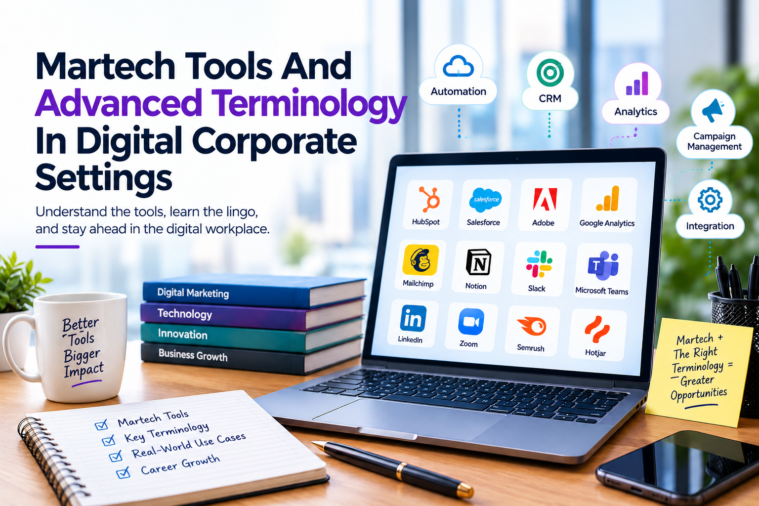
Martech tools and advanced terminology in digital corporate settings
In a modern corporate environment, MarTech (Marketing Technology) refers to the platforms, software, data systems and automation tools used to attract customers, manage relationships, personalise experiences, measure performance and drive revenue.
If you want to communicate confidently in corporate digital marketing, it helps to understand three things: the tools companies use, the technical terminology behind them, and the strategic language used by senior marketing, technology and commercial teams.
1. Essential MarTech tools
A. Customer relationship management (CRM)
Purpose: Manage customer data, sales pipelines, accounts and relationships.

Salesforce
Enterprise CRM for account management, sales operations, customer journeys and marketing integration.
Corporate terminology: pipeline visibility, account intelligence, lead scoring, opportunity management.

HubSpot
CRM, email marketing, marketing automation, lead nurturing and sales enablement, particularly common in B2B and mid-market businesses.
Corporate terminology: inbound marketing, lead nurturing, lifecycle stages, sales alignment.

Microsoft Dynamics 365
CRM and business applications that connect customer operations with the wider Microsoft enterprise ecosystem.
Corporate terminology: enterprise integration, account-based engagement, customer lifecycle management.
B. Marketing automation and campaign management

Adobe Marketo Engage
B2B marketing automation, lead management, campaign orchestration and revenue attribution.
Used for: automated nurture programmes, lead qualification, multi-touch campaigns.

HubSpot Marketing Hub
Campaign workflows, landing pages, email automation, segmentation and conversion tracking.

Oracle Eloqua
Enterprise-grade campaign automation and complex B2B buyer-journey management.
C. Customer data platforms (CDPs) and data management
These tools help organisations consolidate customer information from multiple sources.
Twilio Segment – collects and routes customer data between digital systems.
Adobe Real-Time CDP – unifies customer profiles for audience activation and personalisation.
Tealium – customer data management, event collection and data activation.
Snowflake – cloud data platform for enterprise analytics and data sharing.
Databricks – data engineering, analytics, machine learning and AI.
Advanced terminology: unified customer profile, identity resolution, event-based tracking, data ingestion, data activation, first-party data strategy and data governance.
D. Web analytics and digital intelligence

Google Analytics 4 (GA4)
Measures website and app behaviour, conversions, acquisition channels and user engagement.

Adobe Analytics
Advanced digital measurement, customer journey analysis and enterprise reporting.

Amplitude
Product analytics, behavioural cohorts, retention analysis and funnel optimisation.

Microsoft Power BI / Tableau
Business intelligence tools for dashboards, KPI reporting and executive decision-making.
E. Advertising, paid media and search marketing
Google Ads – paid search, display, shopping and video advertising.
Meta Ads Manager – paid campaigns across Facebook, Instagram and related placements.
LinkedIn Campaign Manager – B2B targeting, professional audiences and lead-generation campaigns.
Google Marketing Platform – enterprise advertising, measurement and campaign management products.
Search Ads 360 – search campaign management and optimisation across supported platforms.
The Trade Desk – programmatic advertising and media buying.
Advanced terminology: programmatic buying, demand-side platform (DSP), supply-side platform (SSP), media mix modelling (MMM), incrementality testing, frequency capping, audience suppression and bid optimisation.
F. Content management, SEO and digital experience
WordPress – website and content management.
Adobe Experience Manager – enterprise content management and digital experience delivery.
Contentful – headless content management and content delivery through APIs.
Semrush – SEO research, keyword analysis and competitor intelligence.
Ahrefs – backlink analysis, organic search research and content opportunities.
Optimizely – experimentation, testing and digital experience optimisation.
VWO – website experimentation and conversion rate optimisation.
G. Email, customer engagement and personalisation
Braze – cross-channel customer engagement and personalised messaging.
Iterable – lifecycle marketing and cross-channel campaign orchestration.
Klaviyo – email and SMS marketing, particularly for ecommerce.
Salesforce Marketing Cloud – enterprise-scale email, journey automation and customer engagement.
Dynamic Yield – digital personalisation and recommendation experiences.
H. Integration, automation and collaboration
Zapier – no-code automation between business applications.
Make – visual workflow automation and system integration.
MuleSoft – enterprise APIs and application integration.
Workato – enterprise workflow and data integration.
Jira – project delivery, issue tracking and agile workflows.
Asana – campaign planning, project coordination and task management.
2. Advanced MarTech and corporate digital terminology
This is the vocabulary that helps you sound knowledgeable in marketing operations, digital transformation, enterprise technology and strategic meetings.
A. Data, architecture and systems
Terminology | Meaning in a corporate setting |
|---|---|
MarTech stack | The integrated collection of marketing technology platforms a company uses. |
Customer Data Platform (CDP) | Unifies customer data from multiple sources into profiles that can be used for targeting and personalisation. |
Single Customer View (SCV) | A consolidated view of a customer’s interactions across channels and systems. |
Identity Resolution | Matching records from different devices, systems or channels to the same customer, where permitted. |
Data Silos | Separate systems or departments that cannot easily share or access information. |
Data Orchestration | Coordinating how data moves between systems and processes. |
API Integration | Connecting applications so they can exchange information programmatically. |
Composable Architecture | Building a technology ecosystem from modular, interoperable components rather than relying entirely on one suite. |
Data Governance | Policies and controls for data quality, ownership, security, access and appropriate use. |
Reverse ETL | Sending transformed data from a data warehouse back into operational systems such as CRM or advertising platforms. |
CDPs, CRM systems, analytics platforms and marketing automation are core elements of many enterprise MarTech stacks.
B. Performance marketing and measurement
Terminology | Meaning |
|---|---|
CAC – Customer Acquisition Cost | The cost of acquiring a customer. |
LTV / CLV – Customer Lifetime Value | The expected value or revenue generated by a customer over their relationship with a business. |
ROAS – Return on Ad Spend | Revenue attributed to advertising divided by advertising expenditure. |
ROMI – Return on Marketing Investment | The return generated relative to marketing investment, with the exact calculation varying by organisation. |
CPA – Cost per Acquisition | The cost of generating a defined acquisition or conversion. |
CPL – Cost per Lead | Marketing expenditure divided by the number of leads generated. |
CTR – Click-Through Rate | Clicks divided by impressions. |
CVR – Conversion Rate | The percentage of users or sessions completing a specified conversion action. |
Marketing Attribution | Assigning credit for conversions to marketing touchpoints or channels. |
Incrementality | The additional outcomes caused by a campaign beyond what would have happened otherwise. |
Media Mix Modelling (MMM) | Statistical modelling that estimates how marketing channels and other factors contribute to business outcomes. |
Marketing Efficiency | How effectively marketing resources translate into measurable outcomes. |
Example of executive language:
“We need to move beyond platform-reported ROAS and validate incremental revenue contribution, blended CAC and customer lifetime value.”
This signals that you’re considering the overall business impact rather than just the advertising dashboard.
C. Customer journeys, automation and personalisation
Terminology | Meaning |
|---|---|
Customer Journey Orchestration | Coordinating customer interactions across channels, systems and lifecycle stages. |
Lifecycle Marketing | Communicating with customers based on where they are in their relationship with the business. |
Lead Scoring | Assigning scores to leads based on fit, behaviour or purchase intent. |
Lead Nurturing | Developing prospects through relevant content and communications over time. |
Marketing Qualified Lead (MQL) | A lead meeting marketing-defined qualification criteria. |
Sales Qualified Lead (SQL) | A lead assessed as suitable for direct sales follow-up. |
Behavioural Segmentation | Grouping audiences according to actions, engagement or usage patterns. |
Predictive Analytics | Using statistical or machine-learning models to estimate future outcomes. |
Next-Best-Action (NBA) | Selecting the most appropriate next interaction for a customer. |
Hyper-personalisation | Using contextual and behavioural signals to tailor customer experiences more precisely. |
Triggered Communications | Messages initiated by an event, such as a signup, purchase or abandoned basket. |
Churn Prediction | Estimating which customers are at risk of leaving or becoming inactive. |
D. Enterprise strategy and digital transformation
These terms are especially useful in leadership meetings, consultancy, corporate presentations and transformation programmes.
Digital Transformation – redesigning business processes, operating models and customer experiences through digital technology.
Business Transformation – broader organisational change involving processes, structures, capabilities and strategy.
Operating Model – how people, processes, technology and governance work together to deliver business outcomes.
Target Operating Model (TOM) – the intended future-state operating model.
Business Capability Mapping – identifying what an organisation needs to be able to do, independently of the specific technology used.
Technology Rationalisation – reducing duplication, complexity and unnecessary software expenditure.
Legacy Modernisation – updating outdated systems, applications or infrastructure.
Systems of Record – authoritative systems that maintain core business records, such as customer or financial data.
Systems of Engagement – platforms through which employees or customers interact with business services.
Cross-Functional Alignment – coordinating different departments around common objectives.
Change Management – helping people and organisations adopt new processes, technologies or ways of working.
Business Case – the documented rationale, costs, benefits, risks and expected return for an investment.
E. AI, automation and emerging digital terminology
Terminology | Meaning |
|---|---|
Generative AI | AI that creates content such as text, images, code or summaries. |
Agentic AI | AI systems that can plan and execute multi-step tasks within defined permissions and constraints. |
AI-driven Personalisation | Using AI models to adapt content, recommendations or experiences. |
Intelligent Automation | Combining workflow automation with capabilities such as AI and decision rules. |
Predictive Lead Scoring | Using predictive models to estimate which leads are most likely to convert. |
Human-in-the-Loop | Keeping human review or approval within an automated workflow. |
Model Governance | Controls for model quality, risk, accountability, monitoring and appropriate use. |
Prompt Engineering | Designing instructions and context to improve the output of generative AI systems. |
RAG – Retrieval-Augmented Generation | Grounding an AI model’s responses in retrieved documents or other external information. |
AEO – Answer Engine Optimisation | Improving the likelihood that content is surfaced or referenced by AI-powered answer experiences. |
AI-enabled workflows, modular technology stacks and automated personalisation are increasingly part of the modern MarTech landscape.
3. Advanced corporate phrases used in digital meetings
Knowing the terminology is one thing; knowing how to use it naturally is another.
DATA & TECHNOLOGY
“We need a single source of truth.”
Meaning: Teams should work from consistent, trusted data rather than conflicting reports from multiple systems.
INTEGRATION
“Let’s assess interoperability across the existing tech stack.”
Meaning: Determine whether the current platforms can exchange data and work together effectively.
PERFORMANCE
“We need to establish clear attribution and measurement frameworks.”
Meaning: Agree on how marketing activities will be measured and credited for outcomes.
STRATEGY
“Let’s align the technology roadmap with business priorities.”
Meaning: Ensure technology investments support the organisation’s strategic goals.
EFFICIENCY
“We should rationalise the stack and eliminate redundant capabilities.”
Meaning: Identify overlapping tools and reduce unnecessary complexity or cost.
CUSTOMER EXPERIENCE
“We need a more cohesive, omnichannel customer experience.”
Meaning: Make interactions consistent across websites, email, apps, sales and customer support.
EXECUTIVE REPORTING
“Let’s quantify the business impact and define measurable success criteria.”
Meaning: Translate the initiative into outcomes, targets and evidence of value.
AI & AUTOMATION
“We should identify scalable, high-value automation use cases.”
Meaning: Prioritise automation opportunities that deliver meaningful benefits and can be expanded reliably.
4. A practical enterprise MarTech ecosystem
Here is how the technologies typically connect in a corporate environment.
Customer touchpoints
Website · Paid media · Email · Mobile app · Sales
Data collection and identity
Tag management · APIs · Consent · Event tracking
Example: Google Tag Manager, Segment
Customer and data platforms
CRM · CDP · Data warehouse
Example: Salesforce, Adobe Real-Time CDP, Snowflake
Activation and orchestration
Segmentation · Automated journeys · Personalisation
Example: Marketo, Braze, Salesforce Marketing Cloud
Measurement and optimisation
Analytics · BI · Attribution · Experimentation
Example: GA4, Adobe Analytics, Power BI
Illustrative architecture, not a mandatory sequence. Actual integrations and data flows vary by company.
5. The most important acronyms to memorise
Acronym | Full form |
|---|---|
MarTech | Marketing Technology |
AdTech | Advertising Technology |
CRM | Customer Relationship Management |
CDP | Customer Data Platform |
DMP | Data Management Platform |
MAP | Marketing Automation Platform |
CMS | Content Management System |
DXP | Digital Experience Platform |
DAM | Digital Asset Management |
BI | Business Intelligence |
CDW | Cloud Data Warehouse |
ETL | Extract, Transform, Load |
iPaaS | Integration Platform as a Service |
ABM | Account-Based Marketing |
GTM | Go-to-Market |
RevOps | Revenue Operations |
CRO | Conversion Rate Optimisation |
SEO | Search Engine Optimisation |
SEM | Search Engine Marketing |
KPI | Key Performance Indicator |
OKR | Objectives and Key Results |
SLA | Service-Level Agreement |
ROI | Return on Investment |
MQL / SQL | Marketing Qualified Lead / Sales Qualified Lead |
6. What should you learn first?
My recommended order for becoming fluent in corporate digital terminology is:
CRM and marketing automation – understand how customer records, leads, campaigns and sales processes connect.
Analytics and performance metrics – master CAC, LTV, ROAS, conversion rates and attribution.
Data architecture – learn APIs, CDPs, data warehouses, integrations and data governance.
Customer journey orchestration – understand lifecycle marketing, segmentation and personalisation.
Enterprise strategy – become comfortable with operating models, technology roadmaps, business cases and transformation.
AI and automation – learn where AI can improve marketing productivity, decision-making and customer experience.
For a corporate professional, the goal isn’t to memorise every platform. It is to understand what business problem each tool solves, how it integrates with other systems, and how its impact is measured.
For further reading, explore the MarTech technology landscape , Gartner’s marketing technology resources , and Adobe’s MarTech guide