
On-Page vs. Off-Page SEO: Key Differences and Why Both Matter
If you want your website to rank higher on Google, you need to understand SEO (Search Engine Optimization). But SEO isn’t just one thing—it’s made up of two main parts: On-Page SEO and Off-Page SEO.
Both are crucial for improving your website’s search rankings, but they work in different ways. In this guide, we’ll break down the key differences between On-Page and Off-Page SEO, why both matter, and how you can optimize your website for success.
What Is On-Page SEO?
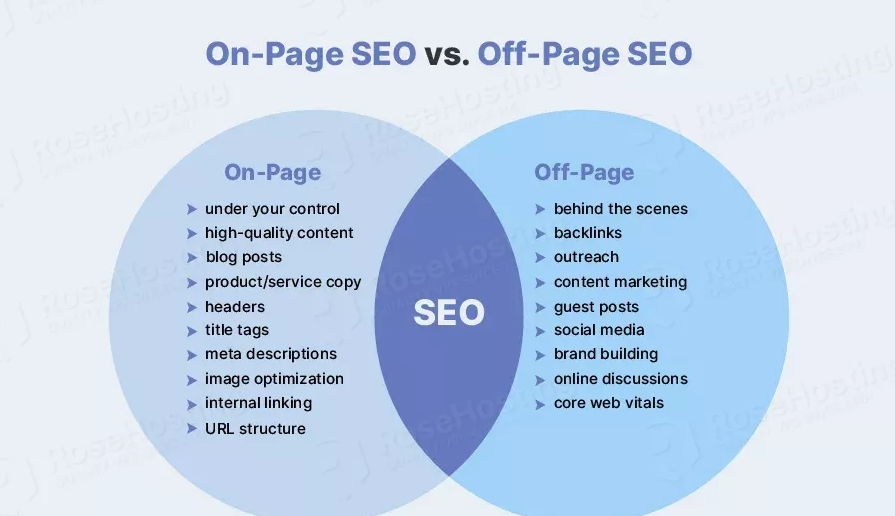
On-Page SEO refers to everything you can control on your website to improve search engine rankings. This includes your content, keywords, site structure, and user experience.
Key On-Page SEO Factors:
✅ Keyword Research – Finding and using the right keywords in your content
✅ Title Tags & Meta Descriptions – Writing compelling headlines and descriptions
✅ High-Quality Content – Creating valuable, engaging, and original content
✅ Internal Linking – Connecting pages on your site for better navigation
✅ Mobile-Friendliness – Ensuring your site works well on all devices
✅ Page Speed Optimization – Making sure your site loads quickly
✅ User Experience (UX) – Making your site easy to use and navigate
Example: If you’re writing a blog post about “best home workout tips,” you should:
Include that keyword naturally in the title, headings, and throughout the content.
Write a meta description that encourages clicks.
Link to other relevant blog posts (like “10-Minute Cardio Workouts”).
Use images and subheadings to make the content easy to read.
Why It Matters: Google ranks web pages based on relevance and user experience. A well-optimized page will attract more visitors and keep them engaged, which improves rankings.
What Is Off-Page SEO?
Off-Page SEO refers to everything that happens outside your website that affects its rankings. The biggest factor? Backlinks—links from other websites to yours.
Key Off-Page SEO Factors:
✅ Backlinks – Getting links from high-quality, authoritative websites
✅ Guest Blogging – Writing articles for other sites to get backlinks
✅ Social Media Signals – Shares, likes, and engagement from social platforms
✅ Brand Mentions – Getting mentioned on other websites (even without a link)
✅ Influencer Outreach – Partnering with influencers to promote your content
✅ Local SEO (for businesses) – Getting listed on Google My Business and directories
Example: If a popular fitness website links to your “best home workout tips” blog post, Google sees this as a vote of confidence, which can improve your ranking.
Why It Matters: Google views backlinks as trust signals. The more high-quality websites link to your content, the more authority and credibility your site gains.
On-Page vs. Off-Page SEO: Key Differences
| Factor | On-Page SEO | Off-Page SEO |
|---|---|---|
| Definition | Optimizing elements on your website | Activities done outside your website to boost rankings |
| Main Focus | Content, keywords, and user experience | Backlinks, brand mentions, and authority |
| Examples | Meta tags, headings, internal links, site speed | Guest blogging, social media shares, influencer outreach |
| Who Controls It? | You (since it’s your website) | Others (since it depends on external websites linking to you) |
| Impact on SEO | Helps search engines understand your page better | Increases website credibility and authority |
Why Both On-Page & Off-Page SEO Matter
Think of SEO as a puzzle—you need both pieces to complete it.
✅ On-Page SEO helps Google understand what your page is about so it can rank it for relevant searches.
✅ Off-Page SEO builds trust and authority by showing Google that other websites think your content is valuable.
A website with great content (On-Page SEO) but no backlinks (Off-Page SEO) might struggle to rank. Likewise, a site with tons of backlinks (Off-Page SEO) but poor content (On-Page SEO) may not stay at the top for long.
To rank higher and drive more traffic, you need a balanced SEO strategy that includes both On-Page and Off-Page SEO.
How to Improve Your On-Page and Off-Page SEO
Step 1: Optimize Your On-Page SEO
✅ Do keyword research and use relevant keywords naturally.
✅ Write high-quality, engaging content that solves a problem.
✅ Optimize your title tags, meta descriptions, and headings.
✅ Use internal links to guide visitors to related content.
✅ Improve page speed and make sure your site is mobile-friendly.
Step 2: Boost Your Off-Page SEO
✅ Get backlinks from authoritative sites through guest posting.
✅ Share your content on social media and engage with your audience.
✅ Build relationships with influencers in your industry.
✅ Get listed on directories like Google My Business for local SEO.
✅ Encourage satisfied customers to leave online reviews.
Final Thoughts: A Winning SEO Strategy Uses Both
If you want to rank higher on Google, don’t focus on just On-Page or just Off-Page SEO—you need both.